Disciplinary Punishment in the Public Service: A Comparative Study
Article Sidebar
Main Article Content
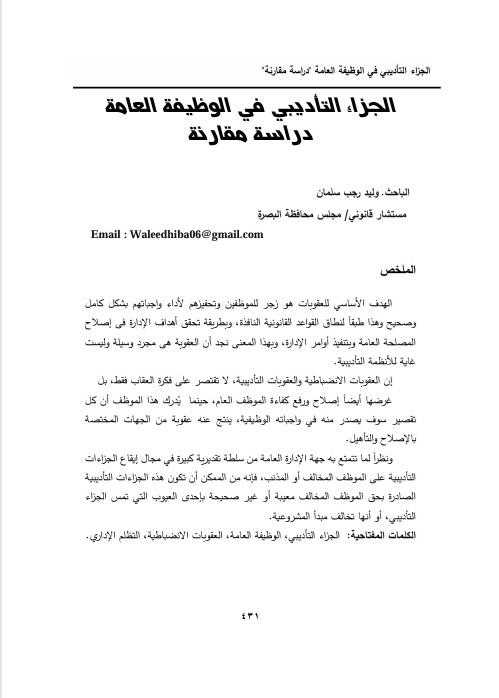
Abstract
Disciplinary sanctions in public service are primarily intended to deter employees and motivate them to perform their duties fully and correctly, in accordance with the applicable legal rules. These sanctions constitute a tool used by the administration to safeguard the public interest and ensure the proper execution of its directives. In this sense, disciplinary punishment is a means rather than an end in itself.
Disciplinary measures are not limited to the notion of punishment; their broader purpose is to reform and enhance the efficiency of public employees. When an employee realizes that any negligence in performing his duties may lead to a penalty imposed by the competent authorities, this awareness contributes to discipline, accountability, and professional improvement.
Given the wide discretionary authority granted to public administration in imposing disciplinary penalties on violating or delinquent employees, such penalties may sometimes be flawed, unlawful, or affected by procedural or substantive defects that undermine their validity. They may also contravene the principle of legality, making them subject to challenge through administrative grievance mechanisms.
Article Details

This work is licensed under a Creative Commons Attribution-ShareAlike 4.0 International License.
References
Research References
-Mohammed Riyadh Mamdouh Al-Sarayrah, The Effect of Administrative Grievances on the Time Limit for Filing an Annulment Appeal, Published Master’s Thesis, Graduate Studies College, Mu’tah University, Jordan, 2020, p. 67.
-Mohammed Khamees Hammadi, The Stage of Concluding Administrative Contracts and Judicial Review of Decisions Issued Therein, Published Master’s Thesis, Faculty of Law, Islamic University of Lebanon, Lebanon, 2021, p. 78.
-Saidani Yassine, The Element of Form and Procedures in Administrative Decisions: A Comparative Study, Master’s Thesis, Ziane Achour University, Algeria, 2016, p. 69.
-Suleiman Al-Rajhi, Suspension of the Execution of Administrative Decisions: A Comparative Study between Jordanian and Kuwaiti Law, Master’s Thesis, Faculty of Law, Middle East University, Jordan, 2013, p. 84.
-Mohammed Riyadh Mamdouh Al-Sarayrah, Previously Cited Reference, p. 70.
-Raed Mohammed Youssef, The Enforceability of Administrative Decisions against Individuals: A Comparative Study between Egypt and Jordan, Master’s Thesis, Middle East University, Jordan, 2012–2013, p. 56.
-Mohammed Khalifa Al-Khiyaili, Administrative Grievances: A Comparative Study between the Laws of the Hashemite Kingdom of Jordan and the United Arab Emirates, Published Master’s Thesis, Faculty of Law, Middle East University, Amman, Jordan, 2009, p. 83.
-Ibrahim Al-Munji, Annulment of Disciplinary Sanctions, Mansha’at Al-Ma’arif Publishing, 1st Edition, Alexandria, 2005, p. 45 ff.
-Ahmed Farqad Qassem, The Requirement of Interest in Actions for Annulment of Administrative Decisions under Lebanese and Iraqi Law, Published Master’s Thesis, Faculty of Law and Political Science, Islamic University of Lebanon, Lebanon, 2018, p. 29.
-Wasan Hamid Zatti, Judicial Review of Administrative Discretion in Assessing Disciplinary Sanctions, Published Master’s Thesis, Faculty of Law, Islamic University of Lebanon, Lebanon, 2022, p. 63.
-Adel Hamad Aboud Al-Jabbasi, Disputes with the Administrative Authority in Administrative Contracts, PhD Dissertation, Faculty of Law, Islamic University of Lebanon, Lebanon, 2021–2022, pp. 172–173.
-Majed Ragheb Al-Helou, Administrative Law, Dar Al-Matbou’at wa Al-Ma’rifa Al-Jami’iyya, no publication year, p. 317.
-Omar Hussein Alwan Mohammed Al-Nadawi, Administrative Measures for Removing Encroachments on Public Funds, Published PhD Dissertation, Faculty of Law, Islamic University of Lebanon, Lebanon, p. 100.
-Othman Suleiman Ghaylan Al-Obaidi, Explanation of the Provisions of the Iraqi Law on the Discipline of State and Public Sector Employees No. (14) of 1991 and Its Amendments, National Library, 1st Edition, Baghdad, 2010, p. 207.
-Iraqi Official Gazette, Issue No. (300), dated 6 February 1960.
-Maher Abdelhadi, Procedural Legality in Disciplinary Proceedings, Cairo, without publisher, 1986, p. 392.
-Abdel Qader Al-Shalakhi, Disciplinary Law and Its Relationship with Administrative and Criminal Law, Dar Al-Furqan for Publishing, 1st Edition, Amman, Jordan, 1983, p. 11.
-Taghreed Mohammed Qaddouri Al-Nughaimi, The Principle of Legality and Its Impact on the Disciplinary System of Public Service, Halabi Legal Publications, 1st Edition, Beirut, Lebanon, 2013, p. 113.
-Judgment of the Egyptian Administrative Court, issued on 21 December 1999.
-Judgment of the Egyptian Supreme Administrative Court, issued on 22 December 2009.
-Mazen Radi Lilo, Administrative Law, University of Duhok Press, 3rd Edition, Iraq, 2010, p. 135.
-Ahmed Salama Badr, Administrative Investigation and Disciplinary Trial, Dar Al-Nahda Al-Arabia Library for Publishing and Distribution, 2nd Edition, Cairo, 2010, p. 100.
-Mostafa Fahmi Al-Gohary, The General Theory of Criminal Sanctions, Al-Bayan Press, Dubai, United Arab Emirates, 1998, p. 28 ff.
-See the Egyptian State Council Law No. (47) of 1972, Article (12).
-See the Egyptian State Council Law No. (47) of 1972, Article (24).
-See the Decision of the President of the Egyptian State Council No. (72) of 1973, dated 12 April 2020.
-Waheeb Eyad Salama & Tharwat Abdel-Aal, A Concise Guide to Administrative Law, Faculty of Law, Assiut University, University Edition, Egypt, 2009, p. 388.
-Mohammed Fouad Mahni, Egyptian and Comparative Administrative Law, Part One, Culture Printing and Publishing House, Alexandria, 2017, p. 341.