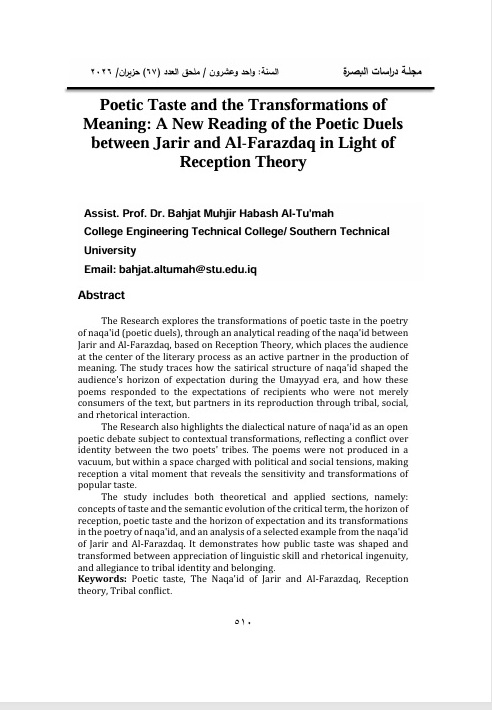
Poetic Taste and the Transformations of Meaning: A New Reading of the Poetic Duels between Jarir and Al-Farazdaq in Light of Reception Theory
Article Sidebar
Main Article Content
Abstract
The Research explores the transformations of poetic taste in the poetry of naqa'id (poetic duels), through an analytical reading of the naqa'id between Jarir and Al-Farazdaq, based on Reception Theory, which places the audience at the center of the literary process as an active partner in the production of meaning. The study traces how the satirical structure of naqa'id shaped the audience's horizon of expectation during the Umayyad era, and how these poems responded to the expectations of recipients who were not merely consumers of the text, but partners in its reproduction through tribal, social, and rhetorical interaction.
The Research also highlights the dialectical nature of naqa'id as an open poetic debate subject to contextual transformations, reflecting a conflict over identity between the two poets' tribes. The poems were not produced in a vacuum, but within a space charged with political and social tensions, making reception a vital moment that reveals the sensitivity and transformations of popular taste.
The study includes both theoretical and applied sections, namely: concepts of taste and the semantic evolution of the critical term, the horizon of reception, poetic taste and the horizon of expectation and its transformations in the poetry of naqa'id, and an analysis of a selected example from the naqa'id of Jarir and Al-Farazdaq. It demonstrates how public taste was shaped and transformed between appreciation of linguistic skill and rhetorical ingenuity, and allegiance to tribal identity and belonging.
Article Details

This work is licensed under a Creative Commons Attribution-ShareAlike 4.0 International License.
References
المصادر والمراجع
أولاً: القرآن الكريم
ثانياً: المصادر العربية القديمة
ـ ابن قتيبة، عبد الله بن مسلم (ت 276هـ)، الشعر والشعراء، تحقيق وشرح: أحمد محمد شاكر، دار المعارف، مصر، د.ت.
ـ الأصفهاني، أبو الفرج علي بن الحسين (ت 356هـ)، الأغاني، تحقيق: إحسان عباس، دار صادر، بيروت، ط3، 2008م.
ـ أبو عبيدة، معمر بن المثنى التيمي البصري (ت 209هـ)، كتاب النقائض: نقائض جرير والفرزدق، وضع حواشيه: خليل عمران المنصور، دار الكتب العلمية، بيروت، 1998م.
ـ ابن منظور، أبو الفضل جمال الدين محمد بن مكرم(ت711هـ)، لسان العرب، دار صادر، بيروت، د.ت.
ـ جرير، ديوان جرير، بشرح محمد بن حبيب، تحقيق: نعمان محمد أمين طه، دار المعارف، ط3، د.ت.
ـ الفرزدق، ديوان الفرزدق، شرح وضبط: علي فاعور، دار الكتب العلمية، بيروت، 1987م.
ثالثاً: المراجع الحديثة
ـ الإبراشي، محمد عطية، وحامد عبد القادر، في علم النفس، المطبعة المصرية، 1934م.
ـ إسماعيل، عز الدين، الأسس الجمالية في النقد العربي، دار الفكر العربي، الطبعة الثالثة، 1974م.
ـ إيكو، أمبرتو، القارئ في الحكاية، التعاضد التأويلي في النصوص الحكائية، تر: أنطوان أبو زيد، المركز الثقافي العربي، الدار البيضاء، ط1 1996م.
ـ زكي، أحمد كمال، النقد الأدبي الحديث، الهيئة المصرية العامة للكتاب، 1972م.
ـ صابر، نجوى، الذوق الأدبي وتطوره عند النقاد العرب حتى نهاية القرن الخامس الهجري، دار الوفاء لدنيا الطباعة والنشر، القاهرة، ط2 2006م.
ـ ضيف، شوقي، التطور والتجديد في الشعر الأموي، دار المعارف، مصر، ط8، د.ت.
ـ ضيف، شوقي، تاريخ الأدب العربي – العصر الإسلامي، دار المعارف، مصر، ط7، د.ت.
ـ ضيف، شوقي، في النقد الأدبي، دار المعارف، مصر، د.ت.
ـ ياوس، هانز روبرت، نحو جمالية التلقي: من أجل تأويل جديد للنص الأدبي، ترجمة: رشيد بنحدو، مراجعة: سعيد بنكراد، دار توبقال للنشر، الدار البيضاء، د.ت.
ـ المبارك، محمد، استقبال النص عند العرب، المؤسسة العربية للدراسات والنشر، بيروت، 1999م.
ـ مجمع اللغة العربية (القاهرة)، المعجم الوسيط، الإدارة العامة للمعجمات وإحياء التراث، مكتبة الشروق الدولية، ط4، 2004م.