Economic Impacts of Population Growth on Electricity Distribution and Consumption in Basra City for the Period 2020-2024
Article Sidebar
Main Article Content
Abstract
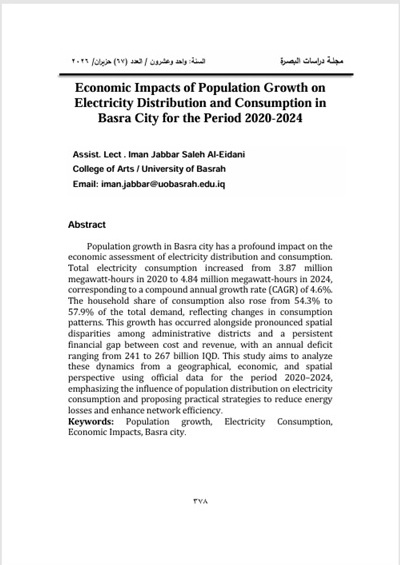
Population growth in Basra city has a profound impact on the economic assessment of electricity distribution and consumption. Total electricity consumption increased from 3.87 million megawatt-hours in 2020 to 4.84 million megawatt-hours in 2024, corresponding to a compound annual growth rate (CAGR) of 4.6%. The household share of consumption also rose from 54.3% to 57.9% of the total demand, reflecting changes in consumption patterns. This growth has occurred alongside pronounced spatial disparities among administrative districts and a persistent financial gap between cost and revenue, with an annual deficit ranging from 241 to 267 billion IQD. This study aims to analyze these dynamics from a geographical, economic, and spatial perspective using official data for the period 2020–2024, emphasizing the influence of population distribution on electricity consumption and proposing practical strategies to reduce energy losses and enhance network efficiency.
Article Details

This work is licensed under a Creative Commons Attribution-ShareAlike 4.0 International License.
References
المصادر
ـ فتحي محمد أبو عيانة ، 1993، جغرافية السكان أسس وتطبيقات، دار المعرفة الجامعية الإسكندرية، الطبعة الرابعة، كلية الاداب، جامعة الإسكندرية، ص614.
ـ باسم عبد العزيز عمر العثمان، عدنان عناد غياض العكيلي، جغرافية السكان، جغرافية السكان، دار الوضاح للنشر، عمان، الطبعة الأولى، 2020، ص 207.
ـ حسون محمد عبدالله واخرون، التنمية المستدامة المفهوم والعناصر والابعاد، مجلة ديإلى، العدد السابع والستون، 2015، ص338.
ـ رشود محمد الخريف السكان، المفاهيم والتطبيقات، دار المؤيد للطباعة، الرياض، 2008، ص178.
ـ علي قاسم العقبي، دراسة وتحليل مؤشرات استخدام الطاقة الكهربائية في محافظة البصرة، رسالة ماجستير، جامعة البصرة، كلية الإدارة والاقتصاد، قسم الاقتصاد، سنة 1986، ص 44.
ـ لمياء حبيب حطيط، النمو السكاني وتأثيره على استهلاك الطاقة الكهربائية (دراسة تحليلية) لعينة من الدول العربية مع إشارة خاصة للعراق للمدة 2023-2004، جامعة القادسية، كلية الإدارة والاقتصاد، قسم الاقتصاد، 2023،35-31.
ـ مريم خير الله خلف، تأثير المناخ على تصميم المساكن في البصرة: دراسة مقارنة بين قضاء المدينة وقضاء الزبير، مجلة الدراسات المستدامة، المجلد 5، الملحق، في مايو 2023.
ـ حسين قاسم محمد فرج الياسري، مجلة دراسات البصرة،31 كانون الأول 2012، مجلد 7، العدد 13، ص33
ـ وزارة البيئة العراقية، "خطة العراق للتنمية المستدامة"، بغداد، 2022.
ـ جمهورية العراق، وزارة الكهرباء، مديرية توزيع كهرباء الجنوب، بيانات غير منشورة لسنه 2025
-Arouri, M. E. H., Ben Youssef, A., M’henni, H., & Rault, C. (2016). Electricity demand in MENA countries: A panel cointegration analysis. Iranian Economic Review, 20(1), 81–94.
-C.W., J.S., and R.B.J. conceived the study. C.W., S.F., and Y.L. analyzed, cImpacts of climate change, population growth, and power sector decarbonization on urban building energy use, nature communications,2023, 14,6434, p6
-García-Lagos, F., Lafta, R., Dhiaa, M., & Al-Khateeb, B. (2024). Addressing energy challenges in Iraq: Forecasting power supply and demand using artificial intelligence models. Frontiers in Energy Research, 12, 1406252
-Hlongwane, W., & Daw, O. (2023). Electricity consumption and population growth in South Africa: A panel approach. International Journal of Energy Economics and Policy, 13(3), 375–383.
-Mansoor Ahmed, The Effect of Energy Consumption, Income, and Population Growth on CO2 Emissions: Evidence from NARDL and Machine Learning Models, sustainability 2023,15,11956, p2
-Stern, D. I. (2011). The role of energy in economic growth. Annals of the New York Academy of Sciences, 1219(1), 26-51.